
(MIDDLETOWN, CT) October 30, 2026 – Federal advertising in the 2026 general election has featured more discussion of government ethics than any of the last eight election cycles (which extend back to 2012), according to a new analysis by the Wesleyan Media Project. Discussion of campaign finance is also at a record high in U.S. House contests, and second only to 2020 in U.S. Senate elections. Although discussion of both issue topics is coming from both parties, pro-Democratic ads are much more likely to feature both topics.
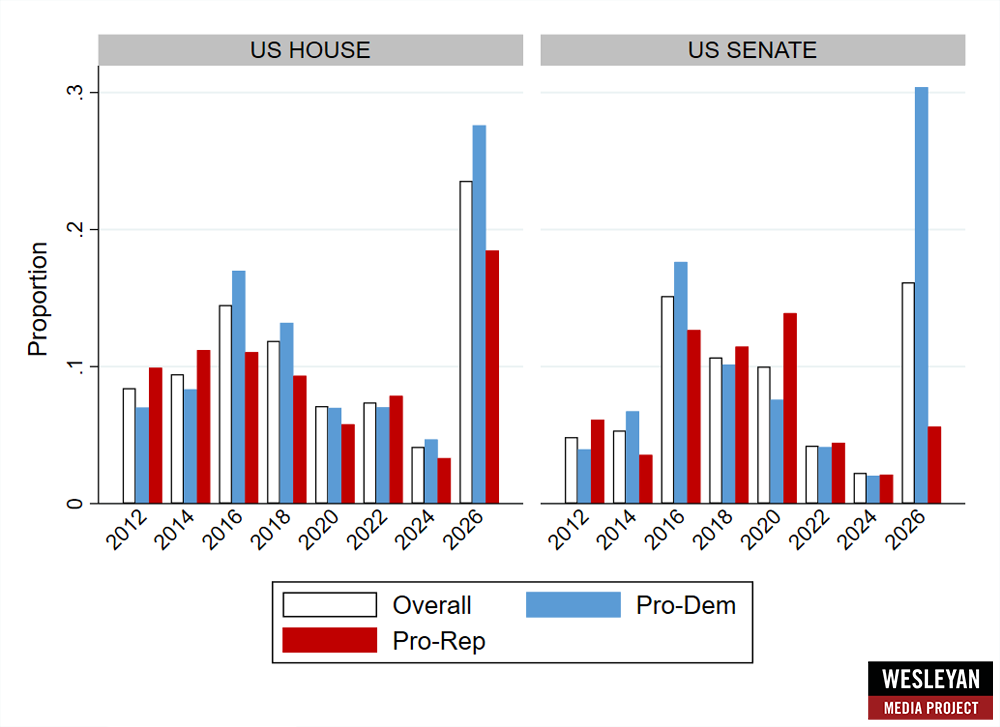
Table 1 and Figure 1 show the proportion of ad airings that mention government ethics by year in general election races, broken down by office and party. The current election cycle is an outlier, with discussion of government ethics much more common than in the previous high point, the year 2016. In most years, the proportion of televised airings devoted to government ethics is pretty even across pro-Democratic and pro-Republican advertising, but 2026 is a huge outlier in this regard as well. Thirty percent of pro-Democratic ad airings in Senate races and 28 percent in House races mention government ethics, while only 6 percent of pro-Republican ad airings in Senate races and 19 percent in House races mention the issue.
Table 1. Government Ethics Mentions in TV Advertising (General Election Only)
| Cycle | Overall | Pro-Dem | Pro-Rep | Cycle | Overall | Pro-Dem | Pro-Rep | |
|---|---|---|---|---|---|---|---|---|
| 2012 | 8.4% | 7.0% | 9.9% | 2012 | 4.9% | 4.0% | 6.1% | |
| 2014 | 9.4% | 8.3% | 11.2% | 2014 | 5.3% | 6.7% | 3.6% | |
| 2016 | 14.5% | 17.0% | 11.0% | 2016 | 15.1% | 17.6% | 12.7% | |
| 2018 | 11.9% | 13.2% | 9.3% | 2018 | 10.7% | 10.2% | 11.5% | |
| 2020 | 7.1% | 7.0% | 5.8% | 2020 | 10.0% | 7.6% | 13.9% | |
| 2022 | 7.4% | 7.0% | 7.9% | 2022 | 4.2% | 4.1% | 4.4% | |
| 2024 | 4.1% | 4.7% | 3.3% | 2024 | 2.2% | 2.0% | 2.1% | |
| 2026* | 23.6% | 27.6% | 18.5% | 2026 | 16.2% | 30.4% | 5.6% | |
| Source: Wesleyan Media Project coding of Vivvix/CMAG and AdImpact data. Note: Includes airings from 9/7-10/11 for each cycle. *2026 US House estimates are based on computational classification of audio only, which may change with visual and human analysis. |
||||||||
Figure 1. Government Ethics Mentions in TV Advertising (General Election Only)
Source: Wesleyan Media Project coding of Vivvix/CMAG and AdImpact data.
Note: Includes airings from 9/7-10/11 for each cycle. 2026 US House estimates are based on computational classification of audio only, which may change with visual and human analysis.
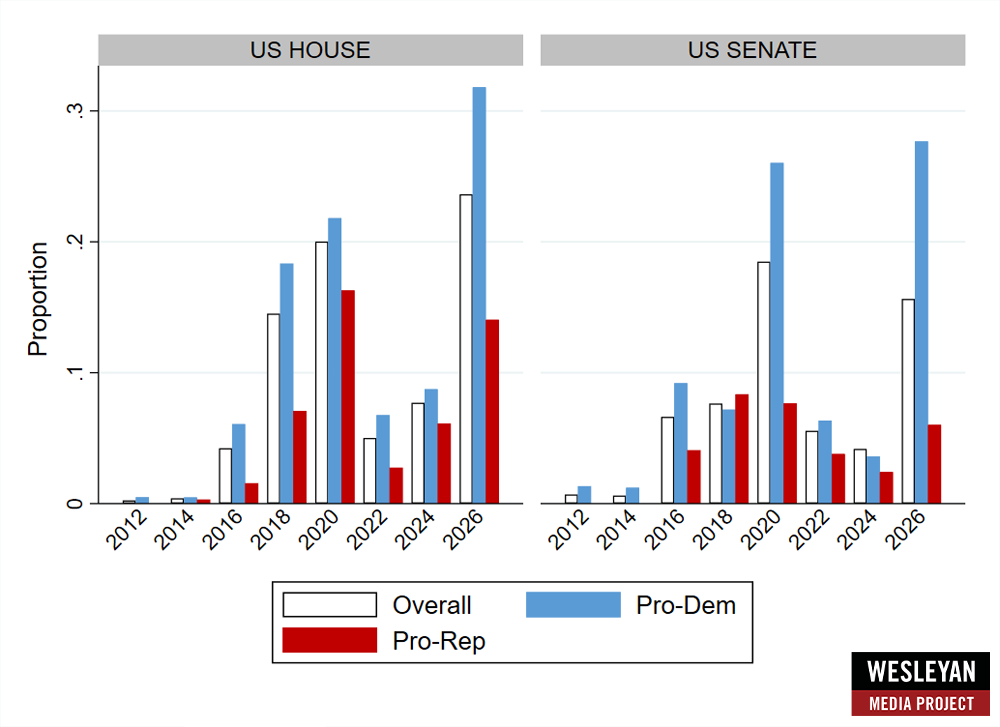
Table 2 (and the associated Figure 2) shows that discussion of campaign finance has ebbed and flowed over time. In the House, the proportion of ad airings mentioning campaign finance was highest in 2026, with the issue mentioned in 24 percent of airings. This percentage was much higher in pro-Democratic ad airings (32 percent) than in pro-Republican ad airings (14 percent). The year 2020 also saw considerable discussion of campaign finance, though the partisan difference in the likelihood of mentioning the issue was much less in that year than in 2026.
In the Senate, the years 2020 and 2026 were peaks for discussion of the issue in the Senate. In both general elections, Democrats were far more attuned to the issue of campaign finance than were Republicans, with over a quarter of pro-Democratic airings in both years mentioning the issue. Only in 2018 did Republican ad sponsors pay more attention to the issue of campaign finance than Democratic sponsors.
Table 2. Campaign Finance Mentions in TV Advertising (General Election Only)
| Cycle | Overall | Pro-Dem | Pro-Rep | Cycle | Overall | Pro-Dem | Pro-Rep | |
|---|---|---|---|---|---|---|---|---|
| 2012 | 0.2% | 0.5% | 0.0% | 2012 | 0.7% | 1.3% | 0.0% | |
| 2014 | 0.4% | 0.5% | 0.3% | 2014 | 0.6% | 1.2% | 0.0% | |
| 2016 | 4.2% | 6.1% | 1.6% | 2016 | 6.6% | 9.2% | 4.1% | |
| 2018 | 14.5% | 18.3% | 7.1% | 2018 | 7.6% | 7.2% | 8.4% | |
| 2020 | 20.0% | 21.8% | 16.3% | 2020 | 18.5% | 26.0% | 7.7% | |
| 2022 | 5.0% | 6.8% | 2.7% | 2022 | 5.6% | 6.3% | 3.8% | |
| 2024 | 7.7% | 8.7% | 6.1% | 2024 | 4.2% | 3.6% | 2.4% | |
| 2026* | 23.6% | 31.8% | 14.0% | 2026 | 15.6% | 27.7% | 6.0% | |
| Source: Wesleyan Media Project coding of Vivvix/CMAG and AdImpact data. Note: Includes airings from 9/7-10/11 for each cycle. *2026 US House estimates are based on computational classification of audio only, which may change with visual and human analysis. |
||||||||
Figure 2. Campaign Finance Mentions in TV Advertising (General Election Only)
Source: Wesleyan Media Project coding of Vivvix/CMAG and AdImpact data.
Note: Includes airings from 9/7-10/11 for each cycle. 2026 US House estimates are based on computational classification of audio only, which may change with visual and human analysis.
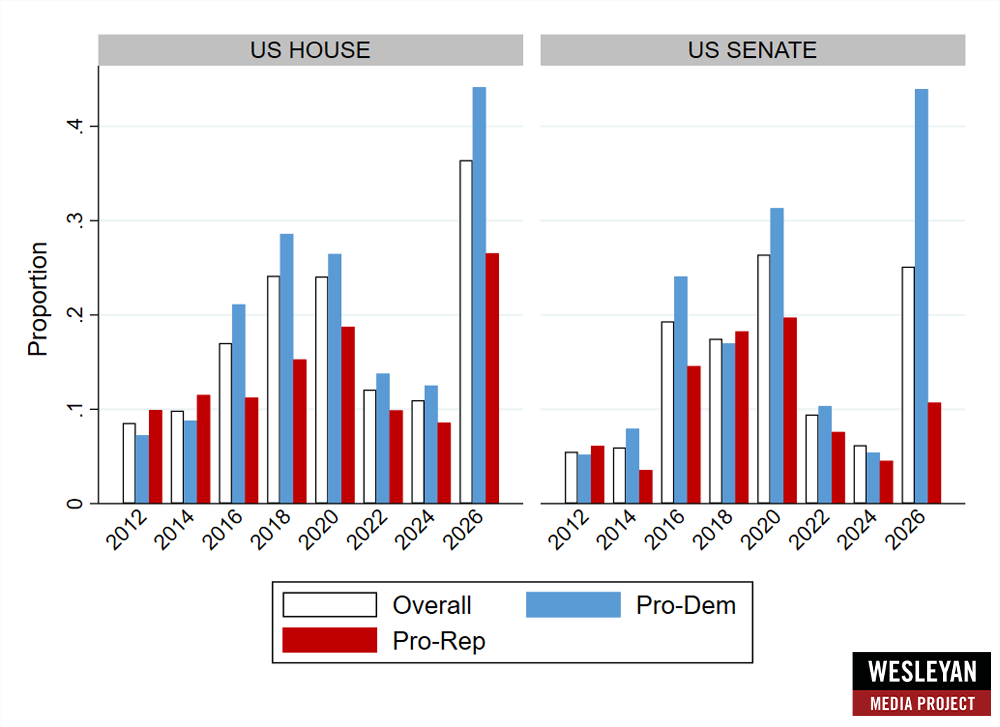
Table 3 and the associated Figure 3 combine mentions of both campaign finance and government ethics. Over four in ten pro-Democratic ad airings in 2026 mention at least one of these issues, while much lower percentages of pro-Republican ads do (27 percent in House and 11 percent in Senate). In the House, discussion of both topics was also high in 2018 and 2020, but discussion in 2026 was 12 percentage points higher. On the Senate side, discussion of campaign finance and government ethics in 2020 was slightly higher overall than 2026. However, mentions of these issues in pro-Democratic airings was much higher across federal races in 2026 than in any other year—and by a long shot.
Table 3. Government Ethics and/or Campaign Finance Mentions in TV Advertising (General Election Only)
| Cycle | Overall | Pro-Dem | Pro-Rep | Cycle | Overall | Pro-Dem | Pro-Rep | |
|---|---|---|---|---|---|---|---|---|
| 2012 | 8.5% | 7.2% | 9.9% | 2012 | 5.5% | 5.2% | 6.1% | |
| 2014 | 9.9% | 8.8% | 11.5% | 2014 | 6.0% | 7.9% | 3.6% | |
| 2016 | 17.0% | 21.1% | 11.2% | 2016 | 19.3% | 24.1% | 14.6% | |
| 2018 | 24.2% | 28.6% | 15.3% | 2018 | 17.5% | 17.0% | 18.3% | |
| 2020 | 24.1% | 26.5% | 18.8% | 2020 | 26.4% | 31.3% | 19.7% | |
| 2022 | 12.1% | 13.8% | 9.9% | 2022 | 9.4% | 10.4% | 7.6% | |
| 2024 | 11.0% | 12.5% | 8.6% | 2024 | 6.2% | 5.4% | 4.5% | |
| 2026* | 36.4% | 44.1% | 26.5% | 2026 | 25.1% | 43.9% | 10.7% | |
| Source: Wesleyan Media Project coding of Vivvix/CMAG and AdImpact data. Note: Includes airings from 9/7-10/11 for each cycle. *2026 US House estimates are based on computational classification of audio only, which may change with visual and human analysis. |
||||||||
Figure 3. Government Ethics and/or Campaign Finance Mentions in TV Advertising (General Election Only)
Source: Wesleyan Media Project coding of Vivvix/CMAG and AdImpact data.
Note: Includes airings from 9/7-10/11 for each cycle. 2026 US House estimates are based on computational classification of audio only, which may change with visual and human analysis.
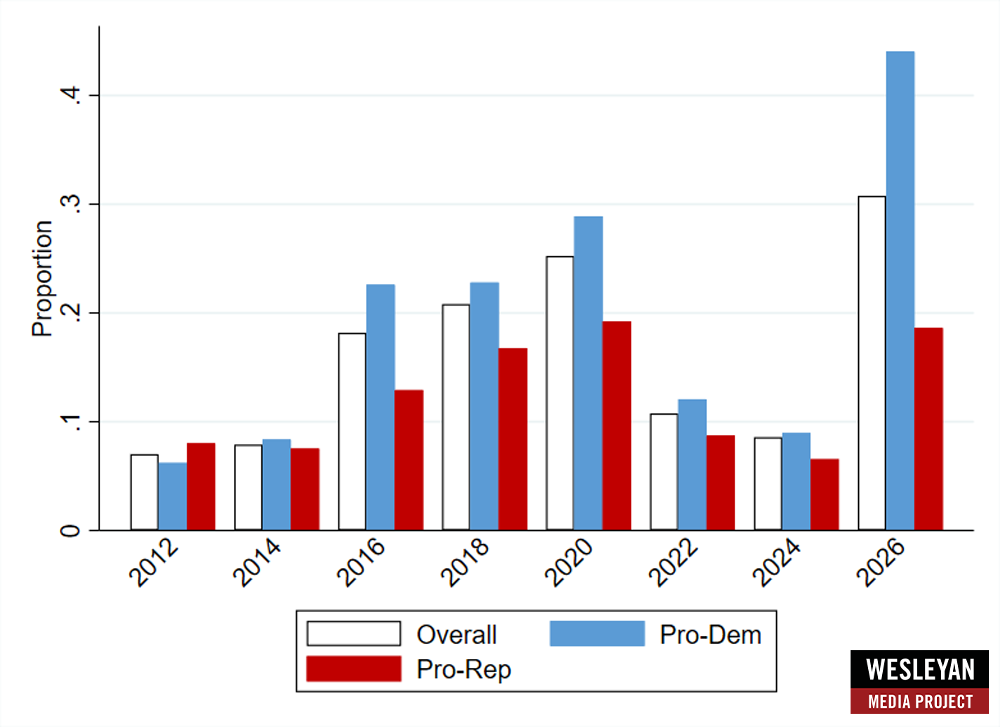
Table 4 shows the combined percentage of House and Senate ad airings that mention government ethics and/or campaign finance. Again, 2026 stands out as a year in which attention to those issues is high, with over 30 percent of airings focusing on one or both the issues. Pro-Democratic ad airings are much more likely to feature such discussion (44 percent) than pro-Republican ad airings (17 percent). Still, the percentage of pro-Republican ad airings that mention these issues in House and Senate races is high by historical comparison, eclipsed only by the year 2020.
Table 4. Government Ethics and/or Campaign Finance Mentions in House and Senate TV Advertising (General Election Only)
| 2012 | 7.0% | 6.2% | 8.1% |
| 2014 | 7.5% | 8.3% | 6.4% |
| 2016 | 18.4% | 22.7% | 13.4% |
| 2018 | 21.0% | 23.3% | 16.8% |
| 2020 | 25.4% | 29.3% | 19.3% |
| 2022 | 10.8% | 12.2% | 8.8% |
| 2024 | 8.4% | 8.9% | 6.2% |
| 2026* | 30.5% | 44.1% | 17.4% |
| Source: Wesleyan Media Project coding of Vivvix/CMAG and AdImpact data. Note: Includes airings from 9/7-10/11 for each cycle. *2026 US House estimates are based on computational classification of audio only, which may change with visual and human analysis and which differ from all other estimates, including 2026 US Senate. |
|||
Figure 4. Government Ethics and/or Campaign Finance Mentions in House and Senate TV Advertising (General Election Only)
Source: Wesleyan Media Project coding of Vivvix/CMAG and AdImpact data.
Note: Includes airings from 9/7-10/11 for each cycle. *2026 US House estimates are based on computational classification of audio only, which may change with visual and human analysis and which differ from all other estimates, including 2026 US Senate.
About the Analysis
Advertising historical airings reported here come from original Wesleyan Media Project analysis of Vivvix/CMAG data for the 2012-2024 cycles and AdImpact for the current cycle.
Advertising content information on issue focus comes from Wesleyan Media Project human coding for both topics for the 2012-2024 time span. For 2026, information on topic mentions in the U.S. Senate is based on ongoing human coding that is 92% complete, and thus percentages may change in the final analysis. U.S. House labeling for 2026 is currently based on our computational issue classifier trained on human content labeling for both issues from 2022-2026. For the “campaign finance” issue, the classifier achieved an F1 score of 0.74, and for the “government ethics” issue, the classifier yielded an F1 score of 0.66, suggesting a moderate degree of reliability between the human and machine ratings. Results may change with added visual components and human coding.